
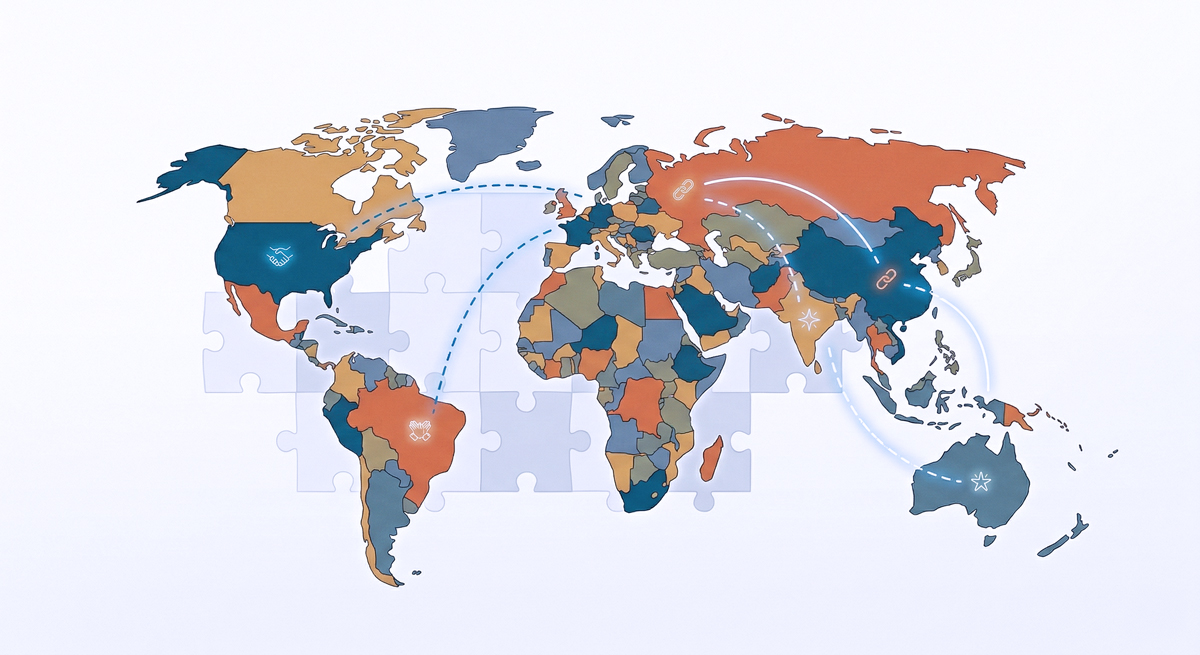
Global markets are navigating a period defined less by synchronized growth and more by fragmentation. Trade relationships are shifting, geopolitical rivalries are reshaping supply chains, and monetary policies are diverging across major economies. For investors, the result is a market landscape where regional dynamics increasingly matter as much as global trends.
This fragmentation does not necessarily signal instability. Instead, it reflects a transition toward a multipolar economic system where capital flows, currencies, commodities, and policy decisions are shaped by competing economic blocs rather than a single dominant growth engine.
The End of the Synchronized Global Cycle
For much of the 1990s and early 2000s, global markets benefited from synchronized economic expansion. Trade liberalization, rapid globalization, and coordinated central bank policies created a relatively predictable macro environment. Today, those conditions have shifted.
Several forces are driving the divergence:
- Central banks are moving at different speeds on interest rate policy
- Governments are prioritizing domestic industrial policy and strategic sectors
- Trade alliances are evolving around geopolitical alignment
- Energy markets are increasingly influenced by regional supply security
As a result, growth trajectories now vary widely across major economies, with some regions tightening monetary policy while others focus on stimulus and industrial investment.
Monetary Policy Divergence
One of the most visible drivers of market fragmentation is the divergence in global monetary policy. While inflation pressures have eased in many advanced economies compared with the peaks of 2022 and 2023, central banks remain cautious about cutting rates too quickly. At the same time, economic growth patterns differ significantly across regions.
Key dynamics shaping monetary policy include:
- The U.S. Federal Reserve balancing inflation control with slowing growth
- The European Central Bank managing weak industrial output and fragile growth
- Emerging market central banks navigating currency stability and capital flows
- Asian economies focusing on export competitiveness and domestic demand
This divergence creates volatility in global capital flows, currency markets, and bond yields, forcing investors to evaluate macro trends region by region rather than through a single global lens.
Supply Chains and Strategic Realignment
The restructuring of global supply chains is another major force behind the fragmented economic order. Companies and governments are increasingly prioritizing resilience over efficiency. After years of relying on highly optimized global supply networks, many industries are now shifting production closer to home or toward politically aligned partners.

Major supply chain trends include:
- Nearshoring and friend-shoring of manufacturing capacity
- Strategic investment in semiconductors, critical minerals, and energy technology
- Industrial policy initiatives aimed at reducing foreign dependency
- Government incentives for domestic manufacturing in key sectors
These structural shifts are reshaping trade flows and influencing which regions attract long-term capital investment.
Commodities and the Geopolitical Premium
Commodity markets are also reflecting the new fragmented economic landscape. Energy, metals, and agricultural commodities are increasingly influenced by geopolitical tensions, resource nationalism, and strategic stockpiling. In many cases, supply disruptions or regional conflicts can move markets as much as traditional demand factors.
Several commodities have become particularly sensitive to geopolitical developments:
- Oil and natural gas amid shifting global energy alliances
- Copper and lithium tied to electrification and renewable energy expansion
- Rare earth minerals essential to advanced manufacturing and defense industries
This geopolitical premium is introducing new layers of volatility while also creating opportunities for resource-rich economies.
Currency Markets in a Multipolar World
Currency markets are adjusting to a world where the dominance of any single economic bloc is less absolute. The U.S. dollar remains the world’s primary reserve currency, but several structural shifts are emerging:
- Increased use of regional currencies in bilateral trade agreements
- Efforts by emerging economies to reduce reliance on the dollar in certain transactions
- Central bank diversification of foreign exchange reserves
- Growth in alternative financial infrastructure in parts of Asia and the Middle East
While the dollar continues to anchor global finance, these developments reflect a gradual shift toward a more diversified currency landscape.
Investment Strategy in a Fragmented Market
For investors, fragmentation requires a more nuanced approach to portfolio construction. Rather than relying solely on broad global trends, successful strategies increasingly incorporate regional economic dynamics, political stability, and sector-specific policy support.
Areas attracting significant investor attention include:
- Energy security and resource infrastructure
- Semiconductor manufacturing and technology supply chains
- Critical minerals and electrification materials
- Defense, aerospace, and cybersecurity industries
Diversification across regions and sectors has become more important as global markets respond to distinct economic and geopolitical forces.
MarketMind Insight – Fragmentation Is the New Framework
The emerging fragmented economic order represents a structural shift rather than a temporary phase. Global markets are adapting to a world where economic power is distributed across multiple regions, each with its own priorities, risks, and policy frameworks. For investors, this environment rewards flexibility, regional awareness, and strategic diversification. The era of synchronized global growth may be fading, but a more complex and opportunity-rich market landscape is taking its place.