
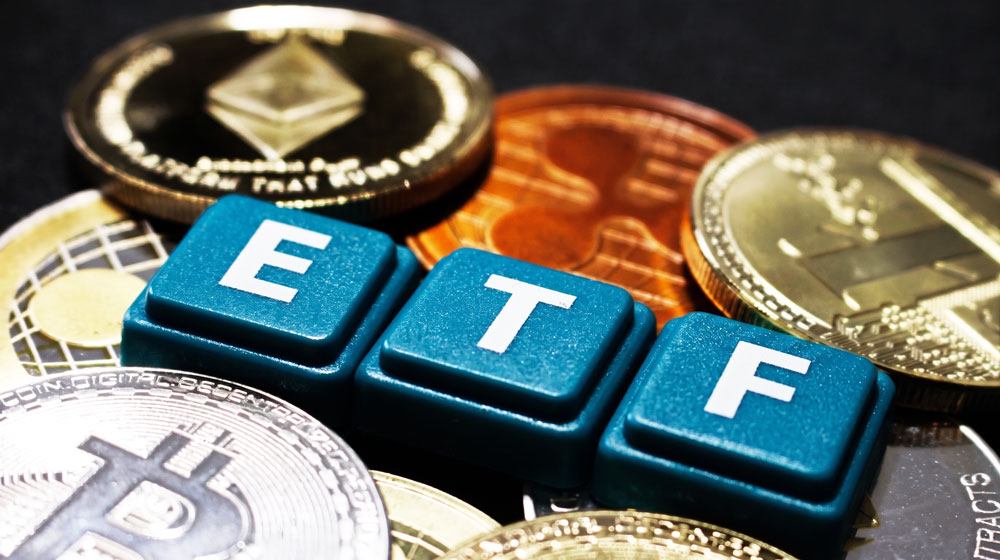
For years, regulated crypto investing largely meant choosing between Bitcoin and Ethereum. That era is ending. The United States now has exchange-traded products offering exposure to baskets of major cryptocurrencies, turning what was once a collection of individual token bets into something that increasingly resembles an investable asset class.
The significance goes beyond convenience. Multi-asset crypto ETFs introduce professional custody, automated rebalancing and rules-based portfolio construction to a market that has historically required investors to manage wallets, exchanges and individual positions themselves. They also give financial advisers a more familiar way to discuss crypto exposure without attempting to identify the next winning network.
Yet these products come with an important warning hidden in plain sight: owning several cryptocurrencies does not automatically create a genuinely diversified portfolio.
Crypto Moves Beyond the Single-Coin Era
The first generation of spot crypto ETFs was designed around individual assets. Spot Bitcoin products opened the institutional door in the United States, followed by Ethereum and an expanding group of single-asset offerings.
Multi-asset products represent the next stage. Instead of tracking only one cryptocurrency, they follow an index or managed strategy containing several eligible digital assets. The portfolio can then be adjusted as market capitalizations, liquidity levels and regulatory eligibility change.
Several major products now define the American market:
- Grayscale CoinDesk Crypto 5 ETF: Holds a market-cap-weighted basket of Bitcoin, Ethereum, XRP, Solana and Cardano, with quarterly rebalancing.
- Hashdex Nasdaq CME Crypto Index ETF: Provides rules-based exposure to a broader group that currently includes Bitcoin, Ethereum, XRP, Solana, Cardano, Chainlink, Stellar and Bitcoin Cash.
- Bitwise 10 Crypto Index ETF: Tracks ten screened crypto assets and rebalances monthly, allowing the portfolio to respond more frequently to changes in the market hierarchy.
- 21Shares FTSE Crypto 10 Index ETF: Offers exposure to ten leading cryptocurrencies through a quarterly rebalanced index strategy.
- 21Shares FTSE Crypto 10 ex-BTC Index ETF: Removes Bitcoin from the portfolio, creating a more concentrated way to access the rest of the large-cap crypto market.
Active management has also entered the category. The 21Shares Active Crypto ETF gives portfolio managers greater discretion to change exposures rather than simply following a fixed index methodology.
This is no longer a single experimental product. It is the beginning of a competitive fund category.
The Regulatory Door Is Finally Open
The shift accelerated when the U.S. Securities and Exchange Commission approved generic listing standards for qualifying commodity-based exchange-traded products in September 2025. Eligible products can now reach exchanges without requiring an individual exchange-rule approval process each time.
That change reduced a major bottleneck. It also gave exchanges and asset managers a clearer framework for bringing additional digital-asset products to market.
The same decision authorized the exchange listing of Grayscale’s diversified large-cap fund, establishing a regulatory path for products holding several spot cryptocurrencies. Hashdex subsequently expanded its index exposure, while Bitwise converted its long-running ten-asset index fund into an exchange-listed ETF structure.
The result is a market moving away from one-off approvals and toward standardized product development. Crypto funds have not become conventional overnight, but the process surrounding them is becoming more systematic.
Diversification Comes With an Asterisk*

The label “multi-asset” may suggest a balanced collection of cryptocurrencies. Most of these products are anything but balanced.
Market-cap-weighted strategies remain overwhelmingly dominated by Bitcoin and Ethereum. In mid-July, Bitcoin represented roughly 78% of both the Bitwise and Hashdex index portfolios. Ethereum accounted for another 12% to 13%, leaving only a small portion for XRP, Solana and the remaining assets.
A fund holding eight or ten cryptocurrencies can therefore still behave much like a Bitcoin-heavy portfolio.
This concentration is not necessarily a design flaw. Bitcoin remains by far the largest and most liquid digital asset, so market-cap weighting naturally gives it the largest position. The methodology also prevents smaller, more volatile tokens from controlling portfolio performance.
But investors should understand what they are buying. A conventional global equity ETF may spread risk across hundreds or thousands of companies, industries and economies. A crypto index holds assets that frequently respond to the same liquidity conditions, regulatory developments and shifts in risk appetite.
Multi-asset exposure reduces the danger of choosing the wrong individual token. It does not remove crypto’s broader market risk.
Index Methodology Becomes the Real Product
As the category expands, the most important distinction may no longer be the number of tokens held. It will be how each fund decides which tokens qualify.
Crypto indices typically apply screens covering:
- Market capitalization and trading liquidity
- Availability of institutional custody
- Regulatory and exchange-listing eligibility
- Trading history and pricing reliability
- Technical or operational risks
- Concentration limits and rebalancing schedules
These decisions can materially change performance. One index may exclude memecoins, privacy-focused assets, stablecoins or tokens with unresolved custody issues. Another may permit a wider selection once the assets meet regulatory and liquidity requirements.
Rebalancing frequency matters as well. Monthly rebalancing can respond more quickly when a new network rises in market value, while quarterly rebalancing may reduce turnover. Neither method guarantees better returns; they simply create different exposures.
The index is no longer a quiet calculation operating in the background. In crypto, the index methodology effectively decides which networks become institutionally investable.
What Investors Actually Gain
The strongest argument for a multi-asset crypto ETF is operational simplicity.
One position can provide access to several cryptocurrencies through a standard brokerage account. The fund handles institutional custody, valuation, portfolio rebalancing and the replacement of assets that no longer satisfy its methodology.
This can be particularly useful for financial advisers and institutions that face restrictions around direct token ownership. An exchange-traded product fits more naturally into established portfolio reporting, compliance and risk-management systems.
Investors also avoid managing private keys, transferring assets between exchanges or maintaining accounts across multiple crypto platforms. Those responsibilities do not disappear; they move to the fund’s custodians and service providers.
The structure may also simplify recordkeeping compared with regularly trading and rebalancing several cryptocurrencies directly. Tax treatment still varies by product and jurisdiction, however, so investors should not assume that every crypto ETF functions like a conventional equity fund.
What the Wrapper Does Not Solve
An ETF structure can make crypto easier to hold, but it cannot turn crypto into a low-risk investment.
The underlying assets remain volatile and highly sensitive to global liquidity, regulation, leverage and investor sentiment. A basket may fall sharply even if every position is held exactly according to its index rules.
Investors also do not own the cryptocurrencies directly. They generally cannot transfer them to a wallet, use them in decentralized applications or exercise the same on-chain rights available to direct holders. The ETF trades during exchange hours even though crypto markets continue operating around the clock, creating the potential for price gaps when traditional markets reopen.
Fees are another consideration. Current management or sponsor fees vary meaningfully across the category, ranging from approximately 0.25% for the Hashdex product to 0.75% for Bitwise’s ten-asset fund, before considering temporary waivers or other expenses.
Liquidity also differs sharply. Established converted funds have attracted hundreds of millions of dollars, while some newer index products remain small and lightly traded. A good concept does not automatically produce a liquid market.
Finally, several spot crypto products are commodity-based trusts governed under the Securities Act of 1933 rather than investment companies registered under the Investment Company Act of 1940. The word “ETF” may appear in their names, but their legal protections and operational structure are not identical to those of a traditional mutual fund or equity ETF.
The Financial-Adviser Opportunity
The multi-asset model may be more important for advisers than for experienced crypto traders.
Advisers rarely want to defend a speculative decision to select one emerging token over another. A transparent index provides a repeatable allocation framework: eligible assets are screened, weighted and periodically rebalanced according to published rules.
That does not make crypto suitable for every client. It does make the allocation easier to monitor and explain.
The approach also changes the conversation from “Which coin will win?” to “How much exposure should this portfolio have to the digital-asset category?” That is a more disciplined question—and one traditional finance already knows how to answer.
A Global Catch-Up Story

Europe reached the crypto-basket stage earlier. Deutsche Börse’s Xetra platform now offers numerous basket-based crypto exchange-traded notes alongside its single-asset products. European issuers have spent years developing physically backed crypto ETPs, sector baskets and index strategies.
The American breakthrough matters because of the scale of its asset-management and financial-advisory industries. U.S. listings can strengthen institutional custody, index development, price discovery and competition over fees.
For Canadian investors, these products expand the range of U.S.-listed choices available through eligible brokerage accounts, although currency exposure, account type and Canadian tax treatment remain relevant.
For investors in Saudi Arabia and the UAE, the category’s growth adds another institutional benchmark for evaluating digital assets. Direct availability will continue to depend on local regulations and brokerage permissions, but deeper U.S. markets can still influence global liquidity, product development and institutional adoption.
The Next Competition Is Over Portfolio Design
The race is no longer simply to launch another Bitcoin fund. Issuers must now differentiate themselves through broader indices, lower fees, more frequent rebalancing, active management and alternative weighting systems.
Bitcoin-excluded products are particularly revealing. They allow investors to separate exposure to the established market leader from exposure to smart-contract platforms, payment networks and other large digital assets. These funds are also considerably more volatile because they remove the asset that normally anchors a market-cap-weighted crypto portfolio.
The category will ultimately be judged on liquidity, tracking accuracy, custody reliability and whether its methodologies continue to represent the investable crypto market. The winner may not be the fund holding the most tokens. It may be the one that most clearly explains why each token belongs in the portfolio.
MarketMind Insight
The arrival of multi-asset crypto ETFs marks crypto’s transition from a collection of individual trades toward a professionally packaged portfolio category. The wrapper makes access easier, but the real investment decision has shifted to index construction, concentration and cost. Investors are no longer being asked to choose only a coin—they are being asked to choose a methodology. As competition grows, the strongest products will be those that combine transparent selection rules with reliable liquidity and reasonable fees. Multi-asset access may broaden participation, but it will not make the underlying market any less volatile. These funds could also become important gateways for advisers and institutions that have avoided the operational burden of holding tokens directly. Their long-term success will depend on whether they can deliver genuine portfolio value rather than simply repackaging Bitcoin dominance under a broader label.